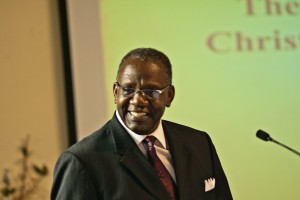
Pastor Olah Moore
Preaching the whole Word of God to the whole person.
Devotionals for encouragement and life application from the Word of God.
You Too Can Make a Difference
Church history demonstrates how believers were intolerant in the face of injustice and changed the world. Even in our nation, African Americans are free because of the intolerance of believers, many of whom were Abolitionists and Freedom Riders – both Black & White. God’s Word does not directly deal with the subject of intolerance, but it does give ample examples of believers who were intolerant of injustice and immorality.
We can learn valuable lessons from an incident in the Apostle Paul’s ministry that is very illustrative. In Galatians 2:11-14, three lessons are apparent. First, great religious and political personalities, even loved ones in our families, can be wrong. Second, our theology prepares us to recognize hypocrisy in the lives of believers as well as blatant satanic reasoning in the lives of unbelievers. And finally, speaking the truth can be a lonely, unpopular encounter. I dare say that the Rev. Martin Luther King, Jr. was energized by this biblical example.
As believers, we have been empowered by the Spirit of God along with the knowledge of Scripture. If there is anyone in the world who can make a moral difference at any time and in any place, it is a Christian. Some of us have different levels of influence. This doesn’t matter. What matters is that each one of us live consistently with God’s Word and be led by God’s Spirit in our daily encounters with everyone. Regrettably, many Christians have become tolerant of injustice as well as immoral behavior.
By definition, tolerance is a fair, objective, and permissive attitude towards those whose opinions, practices, race, religion, nationality, etc., differ from one’s own; it is freedom from bigotry. It is a liberal, undogmatic viewpoint. There are parts of this definition that we can all agree with. However, for the most part, inherent in our faith is a healthy intolerance with what is happening all around us. Consider, for example, what Jesus said in the Sermon on the Mount in the Gospel of Matthew. “You have heard it said …, but I say unto you …” This did not make Him very popular. But it was necessary because when people think and believe wrong, they act wrong. From nearly every quarter, we are told not only to tolerate what others are doing, but it is politically correct to accept and even celebrate how others decide to believe and live their lives.
There are several things to remember about the satanic and unchristian effect of the world’s understanding of what it means to be tolerant. This type of tolerance diminishes justice, weakens our courage and conviction, and skews constructive compassion.
It is only natural that we celebrate those who have demonstrated a healthy intolerance in the face of racism, injustice, and economic inequalities. Nelson Mandela, Dr. King, Mother Teresa, and others come to mind. You too can make a difference in your sphere of influence. Back in the day, we sang a song entitled “Brighten the Corner Where You Are.” In every encounter we experience with injustice and/or immorality, we can either be tolerate or speak truth to culture. “Be bold – be strong – for the Lord, thy God, is with thee.” Now go and make a difference!
Rev. Olah L. Moore
Read more...

A Biblical Manifesto for Millennials
Pastor’s Corner: “A Biblical Manifesto for Millennials”
In Psalm 119:9-16, the acknowledged audience would not be children, but young adults between ages 18 and 34 years old who are called millennials. Millennials make up the largest generation in this age range in U.S. history, they are slower to marry than earlier generations, and more likely to live at home longer, subsequently waiting to move out and live on their own. Sadly, the millennial generation has also been labeled the worst generation ever because so many are involved in immoral behavior. At the same time, however, they are the most educated, with many becoming involved in political issues and social causes. But there is a segment of millennials in the Christian Faith.
What (these) Christian millennials need is a “Biblical Manifesto” to govern their lives, giving them purpose in this dark and spiritually dead world. A manifesto is defined as a written document publicly declaring the intentions, motives, or views of its issuers. It is a strategy or plan to accomplish a desired action. Historic examples on ministers include The Communist Manifesto, the Protestant Manifesto, and the Civil Rights Manifesto. Psalm 119:9-16 is an excellent manifesto for Christian millennials.
Psalm 119:9-10 reads, “How can a young man keep his way pure? By living according to Your . I seek You with all my heart; do not let me stray from Your commands.”
Read more...

Do Not Lean on Your Own Understanding
Proverbs 3:5-6
Trust in the LORD with all your heart, and do not lean on your own understanding.
In all your ways acknowledge him, and he will make straight your paths.
Don’t Lean on Your Understanding
The verse involves a positive–something you must do. But it also involves a negative–something you must not do. Don’t lean on your own understanding. Basically, the verse is telling us that we ought not to be self-reliant. We cannot pursue a course of action, a financial decision, a business move, a relationship, or an educational choice, simply based on our own understanding. It must be founded in our trust in God.
Self-reliance is such a deceptive trap. We begin to pride ourselves in something–our savvy, our looks, our intellect, our spirituality, our family, whatever. And when we do, it takes away our trust in the Lord. It has become trust in self. The result is a dangerous compromise that will lead to destruction.
Instead, Acknowledge God. In Everything.
The antidote to this self-reliance is found in the first command of the verse. “Trust in the Lord with all your heart.” Which is developed in the next verse: “In all your ways acknowledge him.” The word “acknowledge” isn’t merely a polite tip of the hat to the Man Upstairs, or a few words of grace over your meal, or even perfunctory attendance at church to let Him know we’re still cool with what He’s doing. It’s way more. It’s allowing Him access, control, command, and involvement in all your ways.
What’s the result of this? Will God ruin your life? Will he be a Sovereign Killjoy? Will He rob you of fun? The verse ends on a promise. What is it?
He will make your paths straight.
The promise is put in the form of a metaphor. What does it mean to have straight paths? Several things. First, paths lead toward an end–a destination, a goal. Thus, trusting God wholeheartedly in every area of life gives your life a sense of purpose and priority. Second, it indicates that there will be a clear understanding of where you are going and what you are doing. It makes daily decision-making an easier and less painful task. You realize you are trusting Him. He, in turn, is making your paths straight. Thus, the way ahead is more apparent. Third, “straight paths” suggests moral purity. It suggests a life that has less of sinful compromise and more of wholesome attitudes, actions, and behavior.
That’s the kind of life that God promises. It’s the kind of life that you can have. It begins with trust. It involves acknowledging God in every way.
Read more...